Sunday, March 18, 2012

A Brief History of South Africa

         I'm trying to keep up with the blog poss every Sunday, but it's tough! Even though things have been getting very routine, and I have now begun to refer to Langerry Holiday Flats as "home," time has seemed to escape me more and more-- especially with school on top of everything.

          As I've been writing about my time in South Africa, I realized that I may have been referring to some things that everyone back home may not understand. I figure I should give a quick timeline of South Africa up until modern day.

Southern Africa
          South Africa has a very rich and complex history. Some of the oldest remains of human evolutionary ancestors have been discovered in its deserts. Several thousand years ago, South Africa was occupied by several groups of people. The San (Bushmen), who were only 4-5 feet tall, lived in central and southern South Africa. In the western and southern coast were the KhoiKhoi, a rival tribe of the San. In the East and eastern coast were the Bantu people (Zulu and Xhosa). The San eventually came in contact with the Khoi in the West, and have been sometimes referred collectively as the Khoi-San people. The Khoi-San people have left many cave paintings behind. Many of these cave paintings in the Eastern Cape and the Karoo desert depict the Khoi and San paintings painting their small bodies trying to fight off the intimidatingly tall and dark-skinned Bantu people of the East. In time as the groups mixed and mingled, language and culture was exchanged. Xhosa, for example is very prominent in the area where I am living now in the Eastern cape. Many of the black Africans still speak it.
        Xhosa is famous for being a "click language." It has three different clicks: 'X' is a click made from the inner cheek and tongue. 'C' is a sound you make from the back of your front teeth and tongue, and 'Q' is a loud click off the top of ones pallet. It's very cool to hear people speak it so fluently, especially the children.

Afrikaner Commandos during the Second Boer War.
          The colonization history of South Africa has many parallels to the United States. The first major arrival of Europeans was the Dutch East India Company (DEIC) in 1652. The company settled in what is now the Cape of Good Hope in current-day Cape Town. The DEIC built a trading post and port for ships passing by the cape. In about 1795, the British began their take over of the Cape of Good Hope as the DEIC went bankrupt. This take over caused some unrest between the "Boers" (the  Dutch and German settlers) and the British. The conflict was also over mineral wealth in South Africa. The Boers grew tired of the British control in Cape Town, and about 12,000 began a trek across central South Africa to find their own place to live as farmer They settled in central South Africa and fought the British in several wars that are referred to as the Anglican-Boer wars, or the now politically correct, South African Wars. Today, the name Boer has a negative connotation and is avoided.   The British were also at war with the natives as they pushed further inland trying to colonize the land. Forts still remain all over South Africa from the Frontier Wars with the natives. Many cave paintings of the Khoi-San and Bantu people can be found depicting British soldiers standing straight and tall holding their muskets. During this time, Africans and mixed/colored people were subjected to slavery, subservience to whites, and servitude. This was especially prevalent in the densely populated areas such as Cape Town. The overpowering technological superiority and knowledge of the white settlers put the native Africans at a disadvantage and made them out to be inferior. The racial separation (physically, socially, and economically) was already beginning to show. For example,  mixed descendants of the Holland and Germany, or Boers, eventually became known as the Afrikaaners, who speak a mix of German and Dutch referred to as Afrikaans. In the mid 1800s, the racial groups were Africans, Coloreds, Whites (British), and Afrikaaner. After the end of the second Boer war in 1910, the Afrikaaners and British eventually settled their differences and created the South African Union.

          Nelson Mandela was born in 1918, eight years after the creation of the Union. With the election of the National Party in 1948, came the oppression of Africans and colored people in South Africa with the employment of the racial segregation system: apartheid. Before this time, social and economic disparity was already present, and the British were looked up to as educationally and socially superior to Africans. For many non-whites at this time, it was an accepted reality that the whites were superior to themselves. Soon, the oppression of non-whites would become law. With the election of 1948, came oppression of the non-whites through legistlation. One of the most famous Acts was the Group Areas Act, which forcibly moved all non-whites out of the developed areas in South Africa, which were meant to be 'reserved for whites.' The government's reason for the act was 'good neighborliness,' since people meant to be separated into their respective groups where they could develop independently of each other and be 'with their own kind.' (If anyone reading this has seen "District 9, the movie is an allegory to the destruction of a township called District 6 as a result of the Group Areas act, which displaced thousands of people--in fact the entire movie is an allegory to the oppression of non-whites under apartheid). The  forced movement in 1949 left people unemployed since they were unable to afford transport into town where the majority of jobs were. In addition to transportation issues many homes were destroyed, families were separated, and township culture was destroyed. The act only gave non-whites (90% of South Africa) only 13% of the land, while the whites (10% of South Africa)  87% of the land. Without their old homes, shacks were erected in compact neighborhoods, and the non-whites became more and more impoverished without their ability to find work. These became the townships that are still around today. With activists like Mandela, and the creation of the African National Congress and other political parties, human rights movements became more and more prominent. The South African Security Force became violent against the protesters during their protests, boycotts, and peaceful demonstrations. They imprisoned thousands and killed hundreds of people (even more went missing). Even black on black violence became the main source of deaths, resulting in over 20,000 between 1990 and 1994. Eventually after enough conflict and demonstration, an agreement was reached in 1990. The government lifted the ban on political parties such as the ANC. After 27 years in prison as a 'political criminal' and a few years after his release, Mandela was elected president of the new South Africa.

          Granted, this is the whole history of South Africa in a page, there are some other major details missing, but in a nutshell, it helps to get a timeline together. I could have written pages about the last fifty years, but it would just be too much. But today, eighteen years later, South Africa still struggles with the socioeconomic disparities between the whites and non-whites and the after effects of the Group Areas Act. Even so, several of us have run into some pretty racist and bitter Afrikaners that have been open about expressing how they feel about non-whites. The other disparities I can see everyday for myself, especially when volunteering in Missionvale on Mondays and Tuesdays.

Well, in the next few days I will be putting up my Jeffrey's Bay and Hogsback trip blog. Keep an eye out.

Until next post,
Isaak

Sunday, March 11, 2012

Missionvale Update, Addo and Schotia Safari, and Secondary School Volunteering

It's been some time since the last post, and I'm regretting it now. There is plenty to write about what has happened in the last few weeks!

Missionvale

Well, we've been here a month now, and we've volunteered at Missionvale eight different mornings now. As I had said previously, I was scheduled to work in the Garden with Pat and Britt, but each week we volunteer somewhere new just to get a feel for how the Missionvale Care Center (MCC) operates.
Nutrition & Wellness Unit with a fresh delivery
of bread inside.
          For our second week at Missionvale Britt, Pat and I (our usual crew) were transferred to the Nutrition Center. Every single morning when we arrive at Missionvale, there is a line of several hundred people that forms outside on the benches that fill the courtyard of the Care Center. This occurs well before 8:00am when we arrive. People place their bags in a line in front of the window, where the order in line is determined by: the sickest (usually with HIV/AIDS), the handicapped, the mothers (especially the sick or single mothers), then the eldest. These people are all waiting for their daily ration of food from the Nutrition Center, which provides a half loaf of bread and a cup of dried nutrient rich soup powder. Many of these people are dependent on this source of food to survive, but the goal of the Care Center is not to just (in terms of community development theory) "relieve" the poverty, but to "release" the citizens from it. In our service learning course we are learning the difference between the two. Relief is the temporary solution, and release is the long term solution. For example, food handouts would be 'relief,' while education, employment and self-reliance would be 'release' from poverty. To empower and give responsibility to the people of Missionvale who take advantage of the food handouts, the Nutrition Center requires that each recipient present with their wooden card that has been issued to them during a prior visit, or a piece of recycling each day to receive food.

          While the food hand outs are happening, we sit in the back packing food bags that are given weekly to families of the township, especially the sick and those incapable of helping themselves. Each bag is an empty bread bag that is packed with the following:

1 packet of maize meal
1 can of sardines
1 can of baked beans
1 packet of sugar
2 bars of soap
2 teabags

 We became pretty efficient in packing these bags, and soon filled the shelves and carts with over 400 of these bags. The number sounds great (and is great), but we were somewhat disheartened knowing that in the next few days these bags would be completely gone. We started to talk about more sustainable projects for the community that would help release these people from poverty. Our service learning class that meets monthly is dedicated to the understanding and pursuit of sustainable ideas specific to each volunteer site. However, towards the end of our time in the kitchen, we realized there was a need in the kitchen to fill these bags, and relief efforts must be combined with efforts to release them from poverty. We took comfort in the thought. Last week we spent our days in the warehouse packing clothing bags full of two pairs of every form of clothing, including at least two pairs of Tom's Shoes for every single recipient in each family.

       This week, our entire group had the opportunity to partake in the home visits with the care takers. Because of our large group, one of the RNs (Sister Meriel) requested that some of us stay back and help in the clinic. I volunteered to hang back with Mags and Pat. I was more than happy with my choice. I was intimidated at times handling blood that I knew for a fact was HIV positive, even with gloves on. In addition to helping Sister Meriel with some basic procedures in the clinic, I was able to shadow Dr. Strömbeck. Dr. Strömbeck is a primary care physician who has been with the Missionvale Care Center Clinic for some time now, since he closed his private practice. He has decided to give back to the Missionvale community, which I admire greatly. He was excited about having Mags and I in the patient room with him. When Mags told him I was an EMT back at home, he became excited and spent some time telling me about after some of his EMS related schooling in Los Angeles, he helped establish the very first paramedic school in all of South Africa.
          About midday, we saw about a 30 year old woman with some very severe issues. She came to the clinic to get a check up and renewal for her chronic medications, have the doctor sign her grant form for government aid, and check out some abdominal pain. After the assessment, he summed up her case with a list: Tuberculosis, HIV positive, asthma, infection of the abdomen, vaginal infection, urinary tract infection and an abnormal abscess/growth on her scalp due to the HIV and TB. The woman could barely breathe enough for a listen to her lungs and had the doctor drain her scalp. Throughout the day we saw close to 30 some patients, some of whom were pretty similar to this woman. When we told Dr. Strömbeck that our time was up for today, he apologized to us. He said: "I'm sorry you two, I thought today you might see some sick patients. Usually these people are getting carried in by their families and loved ones. Maybe next time?" I was shocked and wrote down what he said in my journal so I would remember it.  I had seen some of the most chronically sick people I may ever see in my life. One of my journal entries was dedicated to my new perception of "sick." The problems that average people suffer from in South Africa do not even match up remotely with what the average patient in the United States deals with.

Walking back with the caretakers from the home visit.
          Today at Missionvale I joined the rest of the crew and caretakers for a home visit. I didn't know what we were getting ourselves into when Dummer, Andrew and I had to carry a whole roll of carpeting through the township. We arrived at a small shack, that was very run down with a woman waiting outside. The shack was no more than 20 feet long and 15 feet wide, with an attached "kitchen." The kitchen was a roofed add on that was about five feet by five feet with a pile of ash in the middle, a broken shovel, and two bricks. We cleared out the entire shack of all furniture and most of her belongings. We began to clean. The guys began to lay and cut the carpeting to lay onto the dirt and moldy carpeting that was barely recognizable anymore. The holes in her tin roof don't do much to keep out the rain. The girls were outside washing dishes and wiping down furniture. We ended up laying the carpet down by digging through old bent nails and hammering them through some old metal bottle caps which functioned as washers to hold the carpet in place. Our hammer for the job was the handle portion of the broken shovel. People make due with what they have in the township. Tools are rare there. With the donations that included table cloths, the carpeting, new bedding, and dishware-- we transformed her home. She was very grateful. Sister Meriel specifically chooses those who she finds to be struggling in their walk through life. She says that these people just need something to keep them going instead of falling into a depressed cycle. This woman was single, and has had a lot of trouble keeping up her home.
Worship before food hand-outs.
          The last few days of volunteering our bus driver has been pretty late picking us up. This has turned out to be a blessing. As we sat and waited for our bus to come pick us up, we listened to the people who have been waiting in line all day for food. They sang, danced, and worshiped giving thanks to God for all of the blessings they have. It was in Xhosa (their native click language), and so we couldn't understand the words. Xhosa is a beautiful language, especially in song. I have never heard such genuine singing and worship, it was very moving. We were all very quiet for the duration of this singing. After the bread and soup hand outs, a sickly man approached me with his newly acquired food in hand and with a mouthful of the bread he mumbled "Thank you! Thank you for helping us. Thank you for coming here to help us. It is so nice to have food in my stomach. Thank you so much." I didn't know what to say to him but I managed to say "You're more than welcome, I'm looking forward to seeing you next Monday. See you then?" I didn't know how else to respond. He held my hand and kissed it several times and with a smile full of bread, he thanked me one more time and limped away through the gate and into the township. I'll never forget it. I have learned that the people in Missionvale are very grateful for the Care Center and Sister Ethel, and have very positive outlooks despite the severe poverty in which they live.

Cricket
          A couple weeks ago, a large portion of the group went to a Cricket game between two teams from the Eastern Cape province. The atmosphere reminded me very much like a Twins baseball game. Everyone sat around trying to figure out the game for themselves or learned about the game by talking to the fans that surrounded us. It ended up being a really fun night under the lights. I'd like to go again soon.


Secondary School Volunteering

        Our literature professor gave us an option of volunteering with her on Thursdays at a local secondary school in the New Brighton Township.  I opted to volunteer with some of the other students from our marine biology class since those in the political science course have class during this time. Our first day at the school was learning about how the school functions, its history, and the changes it has undergone in the last three years. We usually ride into the township with Mary West (our literature professor), who has worked in conjunction with a 30 year old man named Jim at the school. When I met him, I noticed he didn't have the typical South African accent.
       Jim's from  just outside of Philadelphia, and graduated with a business/economics degree in the US and aspired to work on Wall Street. I never got the full story of how he arrived here in Port Elizabeth, but I learned a lot about him. Jim is an amazing guy. Jim lives in the township nearby the school, and works from sun up to sundown seven days a week helping the students, teaching, and managing the school. What is even more incredible, is that he does all of this on only R500 ( South African Rand) a month, which is approximately $66. In the beginning of his time at the school, he focused only on the academics, since there only a 15% graduation rate from the school, and 100% failure in the students' accounting classes. He says the latter is because if the accounting teacher even shows up, more often than not sobriety in the classroom is the issue. It was shocking for us to hear, but he said it incredibly nonchalant.
         In the last few years he has installed electricity, plumbing, and ceilings into the classrooms. The classroom in which he was telling us this, had a broken ceiling. An orphaned student who lives in a tin roofed shack by himself had found his way into the kitchen to steal food, and broke the ceiling when running above the rafters to get away. Jim said it was very difficult to be upset with him. I don't think anyone could be.

Showing my team what a football looks like, how to play, and
talking pre-game strategy. (Jim is walking on the right)
       We went again to volunteer this last Thursday, and got to know a group of kids while helping them with their homework. We'll be working with the same students for the rest of the semester with the goal of building self confidence, social skills, and stimulation with things other than academics. The kids requested that I host an "American Football Day." Which I did this last week. It went great. I haven't had so much fun interacting with the local kids. We taught them four positions: quarterback, running back, receiver, and lineman. They got the general idea and rules, and after teaching them how to throw, we played a game. Jim coached a team, and I coached the other. Soon enough, the kids were improvising, running options and throwing deep hail marys. I told them they need to teach me rugby. The kids got really excited at the idea of teaching me. Things like this have been Jim's goal for us volunteering, since he realized that only after social competency and self confidence will academics begin to improve. He invited us over for a braii (South African equivalent of a barbeque) in the township sometime in the near future. We're looking forward to it. On the drive back, one of the professors who works with Mary drove Margaret and I back. She had trouble finding the school earlier, and she apologized to us. The only reason she didn't know her way around the area was because during Apartheid, it was illegal for her to drive on the roads into the colored and black township we are volunteering in.

Addo Elephant National Park and Schotia Private Game Reserve Safari
         We went on a safari several weekends ago at Addo Elephant National Park, and Schotia Private Game Reserve. At Addo, we drove our big bus slowly through the roads paved through the bush and saw hundreds of African elephants. It is difficult to adequately describe how big they are and the presence they have when lumbering around next to the bus. We took plenty of pictures, and here are a few (the rest are on Facebook):

Addo Elephant National Park

An African elephant approaching the bus.


Elephants cooling off in the watering hole.


        Elephants may appear to be different colors at once or completely different colors overall like the one here in the foreground. The one shown here has been throwing mud and water on itself just like we would put sunscreen on. Different types of mud (and how dry it is) give different colors.


Cars had to move out of the way for this elephant to cross.


        After Addo, we drove about 45 minutes over to Schotia, a privately owned game reserve with every major African animal roaming its plains, including lions that actively feed on the other game in the park. You could see the remains of the eaten animals throughout the park. We drove out into the reserve in mid-afternoon and saw some of the animals native to South Africa and Africa overall including impalas, wildebeest, kudus, white rhinos, warthogs, zebra, monkeys, giraffes, and lions...to mention a few. I even licked a termite mound our guide had kicked open, just for the sake of the girls wanting to take a video of it. I never got some of the termites out of my mouth until dinner that night. We drove around looking at animals and taking turns riding on the front jumpseat of the "landy" as the sun began to set over the reserve. It was one of the most beautiful things I have ever seen in my life.
African sunset at Schotia.


Front seat of the landy.

          I felt like Disney's The Lion King had manifested into reality. Our guide took us to the thatched roof open-air hut that hosted our group dinner: sweet potatoes, ostrich, rice, chicken and green beans. At dinner, we got to know our driver Carl from Port Elizabeth. He went to school and studied game management and has been working at Schotia for six years now. We asked if he hunted and we ended up talking about guns. This was to the girls disappointment and irritation since they were practically drooling over him the entire time. As soon as he and I began to talk, they lost their opportunity to talk and find common ground with him. It was pretty hilarious. He surprised me when he started talking about US politics, Obama's time in office, and gun control. He knew a lot about it and he really surprised me. We compared and contrasted gun control and regulation in South Africa and in the US which was very interesting. He invited me and any of the other guys to come up and shoot his elephant guns at a range close by Schotia. We'll see if it actually happens, but it would be awesome. We ended the night driving through the game park in the pitch dark with spotlights and floodlights that were mounted all around the landy. It kind of felt like Jurassic Park almost, and the animals were much more intimidating in the dark especially after knowing that lions do the majority of their hunting during the night.

Schotia Pictures (the rest are on Facebook):
A young male lion resting with the females (bottom right and corner) with the Schotia game reserve in the background.

Common zebra.
Kudu (pronounced ka-doo)
One of the several giraffes we saw in the park.
We saw the remains of several from the lions feeding.

Female lions with their cubs.
 
White rhino.


Front to back: Wildebeest, warthog, zebras, and impalas with a landy in the distance observing the lions.
Involvment @NMMU
Basketball Club
        On Saturday when we got back, we went to involvement at NMMU. The guys and I looked for basketball, and signed up for the club team. We were all going to play on the club team but it turns out that practices games don't really line up well with our school and weekend schedules. We played several pickup games with the club and my team (Dummer, Bobby, 'Coach' and I) actually placed third in their tournament. At the end of the tournament, the president talked about the clubs mission statment: "to spread the awareness of basketball to NMMU, Port Elizabeth, and South Africa." Basketball is not very big here and it was good to get out and play.

I've got plenty more to talk about for next post, including two more weekends where we went to Jeffrey's Bay and the Hogsback Mountains. Be looking for them!

If you would like to be notified by email when I post, there is a box on the right with instructions on how to do so!

Until then,
Isaak

Monday, February 20, 2012

Classes and Volunteering, Jazz and Soccer, and Seaview Lion Park

Well it's been about week since the last post, and a lot has happened in between.

          Monday was the first day of both volunteering and school for us. Unfortunately there has been a bug running around Langerry. Much of the group, including me, were pretty sick with some form of the cold. Since I chose to volunteer in the Missionvale Township, I wasn't able to volunteer on Monday. It was very disappointing. Since 3 out of every 5 residents of Missionvale are affected by HIV or AIDS, we weren't able to volunteer because of the likelihood of spreading what we had into the township, which could be lethal for over 60% of it's citizens. In my flat alone, Dummer, Norby and myself were sick and couldn't go. The whole situation helped me to again realize where I was in the world, and that the third world problems I learned about on TV as a kid are very real and everywhere here in South Africa. After a little bit of thought and talking with Dummer and Norby, I realized that if we had gone to volunteer, it would have been only for us, and would have defeated the purpose of helping those in Missionvale. I felt better about staying back and catching up on sleep. On Tuesday I was lucky and able to go and volunteer. I worked in the Care Center garden transforming raw land into arable plots. It was rewarding to know that what I was doing was sustainable and had long-term benefits for the community. We planted squash in the newly transformed land.

          I am registered for five different classes at NMMU. I will be taking an Ethics/Intercultural/Senior Seminar class with my professor from Saint John's, South African Literature, South African Music, Marine Biology and a once-a-month service learning class where we talk, reflect and journal about what we have done during our time volunteering. I have one class a day (with volunteering Mondays and Wednesdays in the morning) and each class runs for about three hours, it's a unusual change of pace from the usual class day I may have at SJU. Right now it's hard to pick a favorite class, since they all offer unique and different perspectives on South Africa. I can already tell that they are all grounded in the rich culture, history, and politics of South Africa and I will be learning much more than just what the class syllabus says I should learn. I'm especially excited for our lab practicals and field trips for Marine Biology. Several trips are to the beaches in the area, and there is one where we venture out on a boat into the Indian Ocean. It will be far different than any other science course I have ever taken so far, and I'm excited to learn about large scale marine ecosystems, marine life, and oceanography.

Trying to pet the penguins at Bayworld.
          On the Sunday before school started, several of us went to Bayworld which is a museum/aquarium just down a few blocks from where we live. We saw penguins, seals, and all kinds of fish and snakes. I actually got bit by one of the South African penguins while attempting to pet him when his back was towards me, that was pretty funny. I probably deserved it. There was also a museum with an evolutionary history of life in South Africa and it's oceans. One of the coolest things was the Southern Right Whale skeleton which was over 50 feet long which was suspended from the ceiling. I love aquariums, and when on vacation as a kid, I always asked my parents if we could see the nearest aquarium. My dad can attest to that. What made this museum and aquarium cool is the fact that the Indian Ocean was right across the street and it had many fish and animals native to the area and South Africa.


Local artist showing his art in the township.
               During our previous week of touring service sites and Port Elizabeth, we visited a local township and met an artist right in the heart of it. Out of his very humble and run down home, he was producing incredible art. His art has been displayed alongside those on the same magnitude of Van Gogh. He is a sculptor, and his art was very impressive. The visit to his home really made me think about all of the other talent and potential that is spread throughout these townships. To put it into more of a perspective, it helps to know that the population of Port Elizabeth is roughly 1 million people, and 800,000 of those 1 million people live in townships just like his. Of the roughly 50 million citizens of South Africa, only 5 million pay taxes. How is anything supposed to get done for people in South Africa if there just simply isn't enough to go around? I wondered about all the kids who aspire to become or have the potential to become athletes, engineers, artists, politicians, doctors or businessmen/women, but may never have the opportunity to do so since poverty here is such a deep, cyclic and social rut. For someone to make their way out is an amazing feat. I realized I need to take advantage of everything I have, especially my education. Education, I have realized especially in my first few weeks here in South Africa, is the key to opening many doors in life.

One of the mamas.
          On Tuesday (Valentines Day) we headed into another local township to see a Valentines Days jazz festival. The most unique thing about this experience was where it was hosted, and who was hosting it. Married women who are elders in the township are called 'mamas.' The building that hosted this jazz festival has been built upon a plot where a local tavern used to stand. We spoke to the mamas about the history of the location, and in broken English (since they primarily speak Xhosa, a native 'click' language spoken by many black South Africans), one told us about how the building used to poison and corrupt the men of their town. In rebellion they set fire to the building and destroyed it. The mamas involved were beaten by the Apartheid Police and security forces prior to being hauled away in a military grade armored vehicle called a "casspir" to be taken to jail. One of the mamas (pictured above) still has difficulty walking to this day, but had enough physical and emotional strength to stand up in front of us to tell us her story.


On Wednesday about half of our group went to a soccer game at the Nelson Mandela Bay Stadium. This stadium was the home of the 2010 World Cup, and its architecture was breathtaking:

About twelve of us went along with Gary Prevost, a political science professor from SJU who is down here in PE for a few months, and our study abroad director. The game was between the Kaizer Chiefs and the Jomo Cosmos. The game resulted in a tie, but was still pretty exciting.

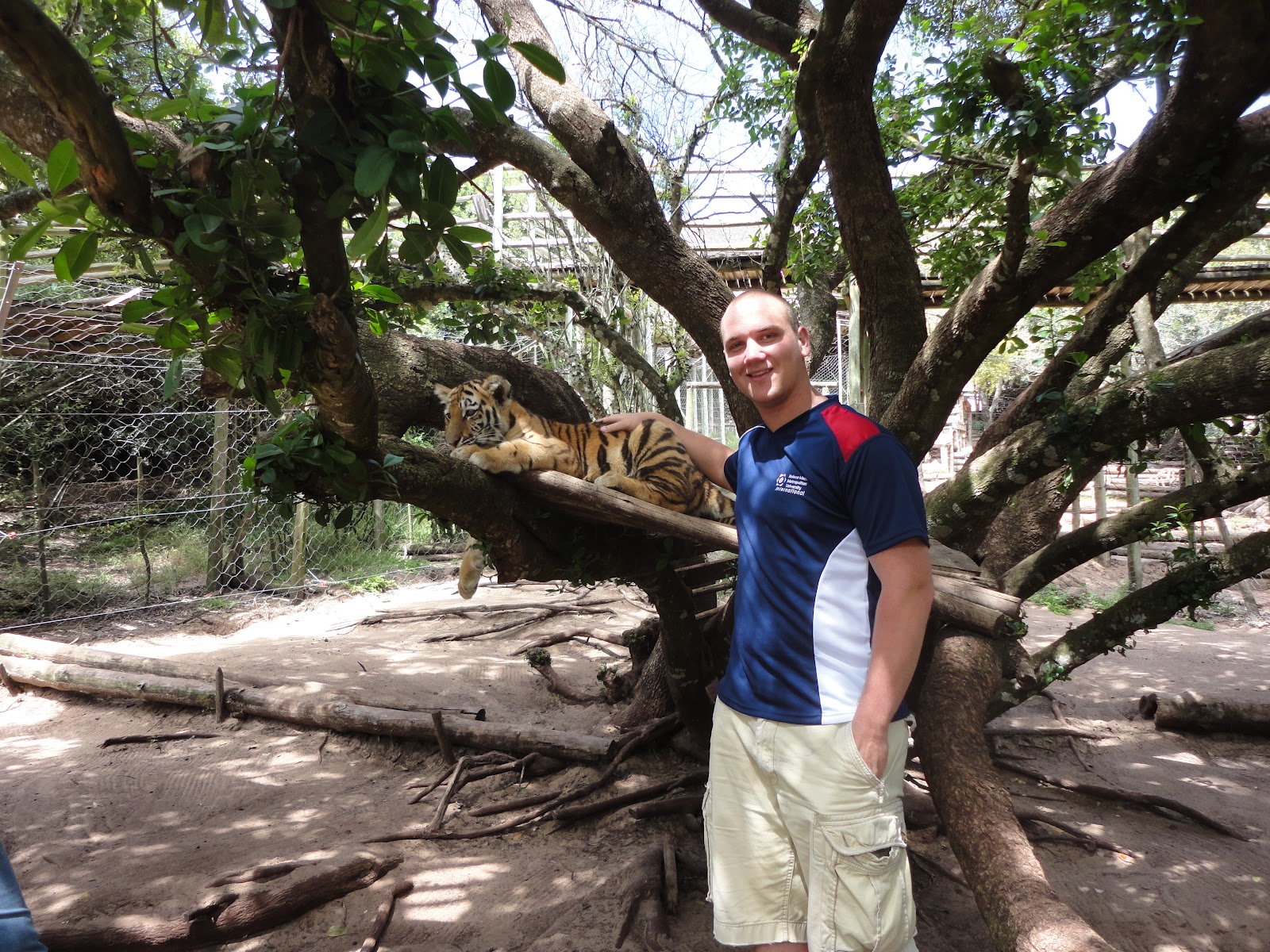
We all took an unscheduled group excursion to Seaview Lion Park about 30-40 minutes out of town to see lions. We ended up seeing more than expected, including giraffes, wildebeest, meerkats, and Siberian tigers. Almost everyone opted to pay the extra fee to interact with their choice of lion and Siberian tiger cubs.

Siberian Tiger cub. There are only 1,000 total left in the entire
world, both in captivity and in the wild.


A white lion.


A giraffe we saw on the drive into the lion park.


A photo of Shakira and Zolani performing together.


           On Saturday, a small group of us took a taxi over to a local music festival. We heard some great live music from a symphony orchestra. They played some great tunes like Queen, Jungle Book, and several other notable songs. We were lucky to hear Zolana Maholah, the lead singer of Freshlyground, the band that worked in junction with Shakira to produce and perform "Waka Waka (This Time For Africa)." She was an amazing artist with incredible talent. She sang as the symphony orchestra played some of her most famous songs. Saturday was also filled with the shenanigans involved with celebrating Sydney's birthday, after we all caught up on homework of course. On Sunday, most of us went to the beach for at least a portion of the day, and later that night while the ladies went out to dinner for Sydney, the guys went to listen to some jazz at a local cafe over a few beers. It was a great way to end the weekend.

Until next post,

Isaak

Saturday, February 11, 2012

NMMU Orientation and Service Sites

This last week has been incredible, in many different ways...it has been full of many ups and downs. I've been completely exhausted one day and completely relaxed the next. I'm trying to keep things short, but I already know it's going to be a long post. I'll try to throw in a few pictures.

NMMU South Campus
      On Monday, we had our international student orientation at NMMU, which was alright, except for all of the logistical stuff we had to go through. Campus is about 3 kilometers (~2 miles) from Langerry. The logistical stuff included our housing information, security, where we shouldn't go in town, and information about the hospitals and police. When they spoke about the police I realized I did notice some different things when walking around PE, such as fences and walls around all personal property, barbed wire (or razor or electrical) fencing on those walls, and the large number of private security companies contracted by homeowners and especially businesses.They assured us that the police are indeed reliable.

          The hosptials and EMS (the state funded ones), however,  seemed less reliable. The state-run ambulance service arrival time may be up to two hours and in the hospital, if you aren't turned away, you most likely won't even see a medical doctor. South Africa suffers from 'brain drain,' which is the movement of the most educated or skilled people out of the country, since they can afford to do so. Because of this, there is a shortage of physicians (especially rurally). NMMU gave us the number for the private ambulance service and private hospitals which provide much greater pre-hospital care (2-4 minute response time) and even greater hospital care for patients.  Margaret, Dummer and I are interested in this health system and are now in the process of setting up physician shadowing at the private hospital, and when we feel comfortable later on, we'll try the state hospitals. We're hoping things will work out. I've also gotten a few responses about ride-along opportunities as an EMT with the local ambulance services in PE, which is very exciting.

       The NMMU Campus is awesome. Around you are palm trees, tropical plants, and umbrella trees that resemble miniature versions of the "Tree of Life" in The Lion King. If you have seen it, you can imagine exactly what I'm talking about. Before I had left for South Africa, I had been told many times that monkeys run around campus in an analogous manner to squirrels in Minnesota, except the monkeys are much more likely to steal food from your hands.

Vervet Monkey
           In a lecture given by our tour guide at our health center stop on campus,  one of her main topics was "what to do if you get bitten by a monkey." I never would have thought I would  hear that speech, so that was pretty funny. We did end up seeing five Vervet monkeys, running around the trees and digging in the trash for food. They are eerily human-like in the way they use their hands, play, and interact.

         I can't speak for the rest of South Africa's universities, but I can say for sure that the students at NMMU are very well dressed in comparison to the average dress at CSB or SJU. Not that it is very surprising, but I just never considered what students in Africa dress like I guess. Sports are huge on campus and when you look at the map of campus, you'll see sports facilities for soccer, cricket, and rugby. The rugby stadium is awesome, but I've heard the team isn't that great. We're still looking forward to grabbing a beer with the rest of the students at the next game. In fact, after the game on Monday we say all of the rugby groupies at Barney's, a local bar. They were all built like rugby players, but we're not convinced it was the team.

       One of the major reasons I chose to go to South Africa was because of the service learning component attached to the program. CSB-SJU has been sending students to NMMU and volunteering at the same service sites for over ten years now (with the exception of one service site). We have spent the last few days touring these sites and Port Elizabeth. There are three service sites:

Pendla Primary School
Pendla Primary courtyard.
          Pendla has just enough educators for grades R-7 (R is their form of Kindergarten) with anywhere from 20-30 learners per classroom. The classes are somewhat run down and old, but still functional. (Most of the school was built in 1941.) We were given a tour with the principal and several of the educators and we had a small meeting where we had a chance to ask questions about the role we would play as volunteers there. Many of the people on the trip are excited to help tutor in math and English and play cricket and other games with the kids throughout the day. The most exciting part of the tour was seeing the library there. On the library was a plaque:

The plaque that was presented at the completion of Umanyano Library.
If you can't read it, it says:

This library was made possible 
with the generous assistance 
and donations received from the
staff and students of the
College of St. Benedict 
and the
St. John's University,
Minnesota, U.S.A. 

Officially opened on
10 May 1999


        It was pretty incredible to see how long of a relationship our school has had with Pendla, Port Elizabeth, and the people of South Africa. I found myself wondering how this contribution changed the lives of the kids who have passed through over the last 10 years and how many more it will in the years to come.

House of Resurrection


Garden of Remembrance
        House is a location for orphans living with or affected by HIV/AIDS in any way shape or form. House has about =50 some residents ranging from birth to age 12, all housed in several buildings. It was opened as an HIV/AIDS haven in the mid-1990's and has continued to do amazing things for the children who have the disease or have lost their parents to it. The children there are very happy, and House has begun a project to house kids of varying age and genders together in a home with a guardian to simulate a family. It is still a work in progress to get the rest of the kids housed in buildings like these.
        Just outside the main building and courtyard is the Garden of Remembrance. For the orphans who have died at the House of Resurrection, their ashes were spread in this garden. It is beautiful and well maintained and does well for preserving the memory of the children who have passed away.


Missionvale Care Center
Warehouse at the Missionvale Care Center
Inside the  Missionvale Township
        Missionvale is a township in the very poor colored area of Port Elizabeth.  It is also the site I have found the most interest in, because of the opportunity to volunteer in the Care Center's clinic pharmacy and work with the Caregivers, the people who provide basic medical care out in the township. The woman who started the Missionvale Care Center has been there for over 25 years now. She has won numerous awards and has been visited by both Nelson Mandela, Mother Teresa, and several other big names.
          To describe what Missionvale looks like in words would never do it justice. Many of us, including me, had a lot of trouble taking in what I was seeing. I'm not embarrassed to say that it was very difficult to hold back tears, as it was for many of the others. Three out of every five citizens of Missionvale are affected by HIV or AIDS. Right when we arrived we witnessed a food handout with hundreds of people waiting in line.  I have never seen so much poverty in my life. I don't like trying to describe what the township looks like by using a Hollywood film as an example, but Missionvale looks very similar to the slums in the "District 9," which actually is set in Johannesburg, South Africa and is an allegory of the Apartheid government that oppressed the non-whites. The movie makes perfect sense to me now after learning the history of Apartheid. On the more positive side, those of you familiar with Tom's shoes, you would probably like to know that Missionvale was a recent recipient of over 30,000 shoes. The shoes make an incredible difference (the shoes fill the blue labeled boxes in upper picture), and the people are very thankful for it. Besides all of that though, I'm really looking forward to taking on the big projects and trying to do what I can to improve the lives of these people in Missionvale.


        We took a tour of the city prior to touring our Missionvale Service site. We saw many of the old landmarks and learned a lot from our tour guide, Bradley. He was the one who spoke to us Bush Camp about the history of South Africa and other social issues. We took the bus into the townships and when we arrived, the NMMU Missionvale Campus, was immediately across the street. It's brand new, flashy, and very modern. 200 meters away was one of the poorest areas of Port Elizabeth, with shacks made from whatever scrap they could find. I looked to the distance over the roof tops of the shacks, and saw the beach, tall white buildings, and the street we lived on in the very far distance. I started thinking about how polarized everything is in South Africa. The haves, the have-nots. The wealthy, the poor. The whites, the non-whites.  Beach Road (where I live), and township slums 15 minutes away. I could keep going on and on. I can see this becoming very mentally and emotionally draining as we begin our time at our service sites this next week moving between two different worlds. Past students have told me that it really is. There were a few people who actually became edgy and sensitive in response to what others were complaining about later that day, no matter how small.
Missionvale Township in the foreground, Beach Road in Humewood
and west Port Elizabeth in the background.
        It lead to discussion between a few of us about where we draw a line about playing the 'starving or poor people in Africa card,' now that we have actually seen this in person. It is a God-given gift to be healthy and have everything that we do. But should we dwell on what we had just seen and let it penetrate into every facet of our normal day or routine? That would be too overwhelming. We never came up with any definite answers, but we have certainly been thinking about it.


Until next post,
Isaak


Sunday, February 5, 2012

Bush Camp, Market and Surfing


This past weekend we went to  "Bush Camp" at Tsitsikama National Park. It was approximately a two hours drive from Port Elizabeth. 


CSB-SJU South Africa 2012
Nelson Mandela Metropolitan University's Office of Education Abroad hosts Bush Camp, the international student orientation that involved students from America (including some from SCSU), Germany, Finland, the Netherlands, Botswana, and Zimbabwe... to mention a few. It was raining and very foggy for the two hour drive to the national park so many of us were not able to see much of the surrounding scenery. One thing we did see was a group of fifteen baboons crossing the highway less than 15 meters in front of us. The way our driver reacted was similar to a Minnesota driver who had seen deer running across the road, pretty casual. Our inability to see around us for the whole drive up made our first view of the mountains, jungle and river where we stayed that much more impressive on Saturday. Early on Saturday morning a few others and myself were able to witness part of the African sunrise which revealed our first glimpse mountains, it was incredible. Friday night we had African drumming lessons and during the day on Saturday we went zip lining through the jungle and down the river where there were large waterfalls, pools, and all kinds of foliage we had never seen before.

A portion of the zipline course.
 
Bush camp was very fun, but we weren't messing around the entire time. We listend to several lectures, and one of them was especially moving. The selected speaker for us has been involved with CSB|SJU students for many years here in South Africa. He was given the task of providing an overview of South Africa's history to us, in two hours. To begin, he spoke about the racial inequality in South Africa. He also touched on how the Chinese, Dutch, German, American, and especially the British have shaped South Africa. Only about half of his lecture was on the history, however. Despite my love for history, it did not disappoint me. He went on to speak about his skin pigment condition and how it has affected his life here in South Africa. Although he is mostly white, there are portions of his skin that have brown pigment and discoloration. Until recently, because of both his mixed Dutch and Native lineage and his skin condition, he has always been categorized as "colored." He then talked about those who used to be difficult to categorize. There used to be three tests (listed in order) to determine the category of these people: the tone of skin, running a pen through the persons hair to see if it gets caught (if it did, they were colored or black), and the width of the person's nose. He never made it past the first test. He was a revolutionist who opposed Apartheid and is now a middle aged man. Currently, he is a student just like us. This would not be too unusual except for the fact that he never was allowed to go to University, only whites were able to under Apartheid. Knowledge is power, some say. I spent some time later that day reflecting on what I had heard and how lucky to be where I am at this time in my life. I certainly realized I was only beginning to scratch at the surface of the social, political, and economic complexity of modern South Africa. I can't wait for classes to begin.

Hiking the mountains in Tsitsikama National Park.
That  afternoon we went hiking up through the woods and up one of the nearby mountains which provided some spectacular views of the surrounding South African countryside.
On the drive back on Sunday we were able to see all of the mountains and scenery around us, including an all encompassing view of Jeffreys Bay, a very beautiful location just outside of PE. Jeffereys Bay is home to some of the world's best surfing, and is also the home of the Billabong clothing factory. On the drive back we were stopped at a police roadblock where every single vehicle had their engine, plates, cargo and passengers checked, for multiple reasons. From what we were told it's pretty common and it is their form of enhanced highway security. The drive back was topped off by a glimpse of several wild zebra and ostriches just off the road a short ways.

View from our balcony with King's beach in the background.
When we got back to Langerry in Port Elizabeth several of us checked out the flea market, bought a few souvenirs for those back home, or fake brand name sunglasses. Pat actually bought a 100 trillion dollar bill from  Zimbabwe. (It was from when Zimbabwe was suffering from hyperinflation.) When the vendor asked if he was interested in purchasing another bill to add to the collection he replied "No way man, I think I'm pretty set with 100 trillion dollars." He just walked away without saying anything else. That was pretty funny. After the market, we made lunch at Langerry and went to the beach where we played with a dead jellyfish, burnt the remaining white skin that hadn't already been burnt this weekend, and attempted surfing with an old surfboard left behind by previous CSB|SJU students. 


Tonight, us guys are planning to screw up our newly adjusted sleep schedule all over again in order to try watching the Superbowl with the rest of Port Elizabeth's football-loving Americans in the local casino. The game starts at 2:00am local time.

I plan on posting every time new and big things are happening over here, and I suppose that in the first few weeks there will be plenty of things to write about. I'm sure it'll slow down as school starts factoring into my time here.

Cheers,
Isaak